Interested in learning more about how paid remarketing ads can be used to support nonprofit organizations and the critical work they do?
Book a CallMany people who discover a nonprofit through a Google Ad Grant link are taking an important first step in their journey with your organization. They click an ad, explore key pages, and begin learning about your mission. By using thoughtful remarketing strategies, nonprofits can build on that initial engagement and ensure as many interested visitors as possible take meaningful next steps — whether that’s subscribing to a newsletter, volunteering, making a donation, or something else.
What Google Remarketing Is and Why it Matters
Standard Google remarketing involves showing ads to people who have previously interacted with your organization’s website, mobile app, or online content. This approach focuses on users who already recognize your brand, making ads more relevant and more likely to drive action. Instead of advertising broadly, remarketing narrows your audience to people who have already demonstrated interest.
For nonprofits, this matters because supporters often need time before committing. Donations, volunteer signups, and event registrations rarely happen on the first visit. Remarketing allows your organization to continue the conversation throughout the user decision-making process rather than starting from scratch every time.
How Remarketing Works Behind the Scenes
Remarketing relies on small pieces of code called tags that are placed on your website. These tags collect anonymous information about visitor behavior and allow Google Ads to group users into different remarketing audiences. Google Tag Manager is commonly used to manage these tags because it allows organizations to add and update tracking without constantly having to modify site code.
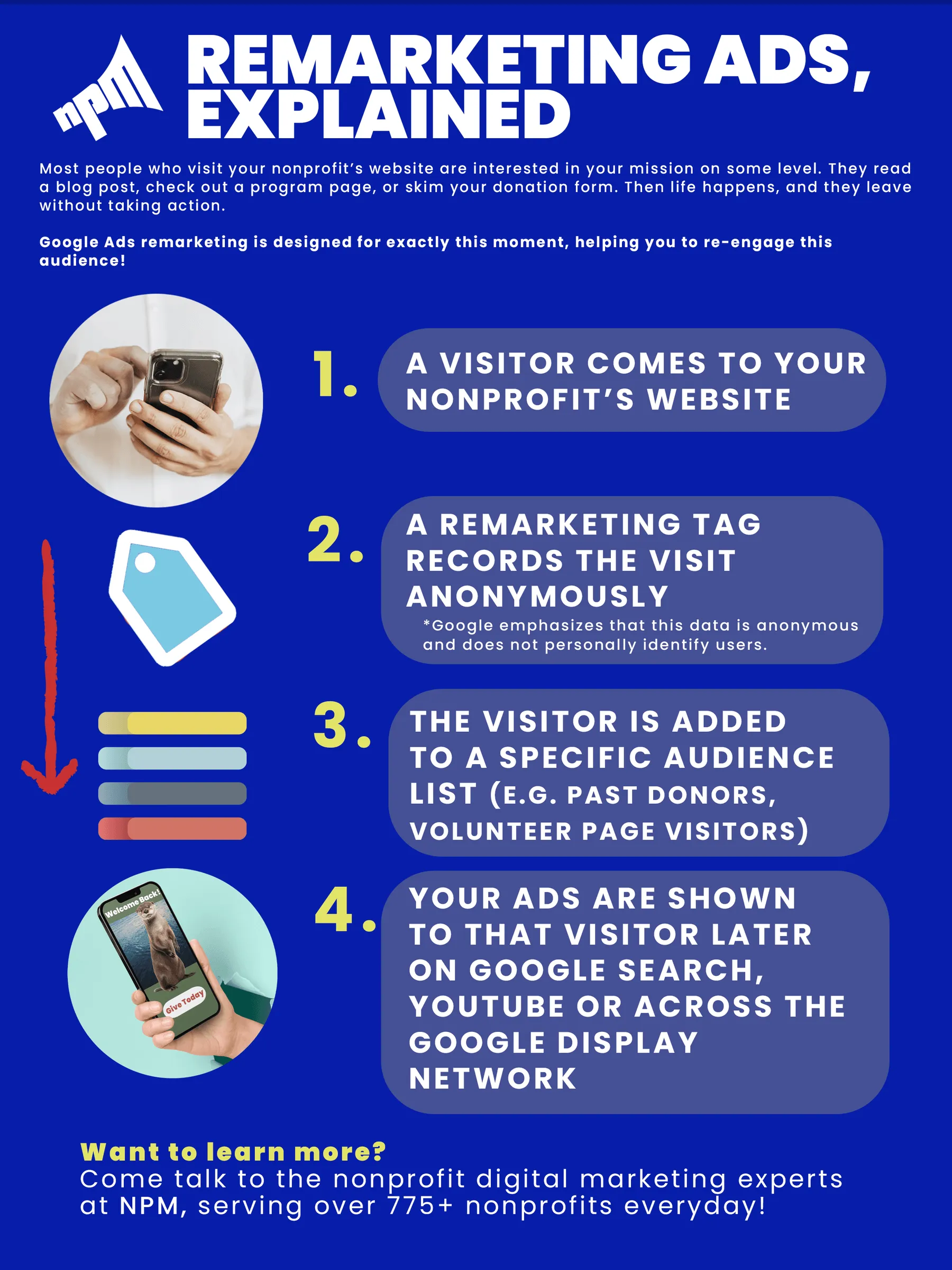
The process looks like this:
- A visitor comes to one of your nonprofit’s website landing pages
- A remarketing tag records the visit anonymously
- The visitor is added to a remarketing list, such as donation page visitors or blog readers
- Your ads are shown to that visitor later on Google Search, YouTube, or the Google Display Network
Google emphasizes that this data does not personally identify users. It simply allows ads to be shown based on prior engagement, which is why remarketing feels more relevant than general advertising.
How Remarketing Ads Extend the Impact of the Google Ad Grant
The Google Ad Grant gives nonprofits an incredible opportunity to appear in search results when people are actively looking for services, programs, or causes related to the missions of those nonprofits. But even the strongest Search campaign has a natural limitation. Many users click, explore, and leave before taking action, especially if the encouraged action (such as a donation ask or a call for volunteers) requires a degree of commitment.
This is where remarketing plays a critical supporting role. When used alongside the Google Ad Grant, remarketing allows nonprofits to continue engaging people who already discovered their organization through Grant ads, reinforcing interest and guiding them back when they are ready to act.
Rather than replacing the Ad Grant, remarketing works best as a second layer that builds on the traffic the Grant generates in the first place.
Understanding the Role of the Google Ad Grant in the Funnel
The Google Ad Grant is designed to drive high-intent traffic through Google Search ads. Grant ads appear only on Google Search and are triggered by popular search terms or questions related to your mission, services, or programs. This makes the Grant especially effective at reaching users who are already motivated to learn, seek help, or get involved.
However, the Grant has built-in constraints:
- Ads are limited to Search only
- Google Ad Grant Campaigns rely heavily on keyword intent
- Low-funnel conversions often require multiple visits
- Ads stop showing once users leave Search
For nonprofits making asks that lend themselves to longer decision cycles, this can create a gap between initial interest and eventual action. Remarketing is designed to bridge that gap before they widen out of reach.
How Remarketing Builds on Grant Traffic
Remarketing works best when it is fed by strong website traffic. The Google Ad Grant helps supply that traffic at no cost, making it an ideal entry point for building remarketing audiences.
Nonprofits typically use the Grant to attract users first, then rely on paid remarketing campaigns to stay connected afterward. This creates a clear division of labor:
- The Ad Grant introduces your nonprofit to motivated searchers
- Remarketing reinforces your message after the initial visit
Once someone clicks a Grant ad and visits your website, they can be added to a remarketing audience. From there, each paid Google remarketing campaign can re-engage them across Search, Display, YouTube, and Gmail — channels that are not available through the Grant alone, massively widening its impact.
Strategic Ways Nonprofits Use Remarketing With the Grant
Remarketing is most effective when it is thoughtfully aligned with the Google Ad Grant traffic that fuels it. At a foundational level, nonprofits can re-engage past website visitors to reinforce awareness and encourage follow-up actions using basic remarketing tactics. For organizations seeking to go further, however, more advanced remarketing strategies allow audiences to be refined based on on-site behavior, enabling more tailored messaging and stronger performance as campaigns mature.
Common Grant-supported remarketing strategies include:
- Re-Engaging Donation Page Visitors. Users who clicked a Grant ad and viewed a donation page but did not complete the process can be reminded later with tailored messaging.
- Following Up With Program Page Visitors. People who searched for services through Grant keywords can later see ads highlighting eligibility, outcomes, or next steps.
- Supporting Event Promotion. Grant ads drive early awareness, while remarketing reinforces deadlines and registration reminders.
- Encouraging Deeper Engagement. Blog readers and resource users can be invited back to sign up for newsletters or explore related programs.
In each case, the Grant captures initial intent, and remarketing supports follow-through.
Why This Combination Improves Performance
Remarketing audiences are inherently warmer than general audiences. Users who have already interacted with a brand are more likely to click ads and convert because the trust-building process has already started.
For nonprofits, this matters because:
- Supporters often need reassurance before acting
- Donations and volunteer commitments are rarely impulsive
- Repeated exposure builds credibility and familiarity
By pairing Grant traffic with remarketing, nonprofits reduce friction in the decision-making process and make better use of both free and paid advertising resources.
Budget Efficiency and Smart Allocation
While basic remarketing strategies are useful and can drive warmer audiences toward your priorities, their effectiveness can be limited. More advanced remarketing strategies often deliver stronger results per dollar. Nonprofits using advanced remarketing alongside the Grant typically see improved conversion rates because ads are shown only to users who already expressed interest.
This allows organizations to:
- Spend modest budgets more effectively
- Avoid broad, unfocused targeting
- Prioritize the users who are most likely to convert
Rather than competing for attention in crowded ad spaces, nonprofits stay visible to people who have already chosen to engage.
Compliance and Best Practices When Pairing Both Approaches
To get the most value from this combination, nonprofits should keep a few best practices in mind:
- Maintain clear separation between Grant and paid accounts
- Ensure remarketing ads comply with Google policies
- Use frequency limits to avoid ad fatigue
- Align messaging with the page users originally visited
Remember, relevance is critical. Ads should feel like a helpful reminder, not a repetition of the same message users already saw.
Turning One Click Into an Ongoing Relationship
The Google Ad Grant is exceptional at opening the door. Remarketing helps keep that door open.
When nonprofits use the Grant to attract motivated searchers and remarketing to re-engage them afterward, they create a more complete digital journey. Interest turns into familiarity. Familiarity turns into trust. Trust makes action more likely.
Together, these tools allow nonprofits to move beyond one-time clicks and build lasting engagement with the people who care most about their mission.
Getting Expert Help With Google Remarketing Ads
While remarketing is powerful, it does require thoughtful setup, audience strategy, and ongoing optimization. From managing tags correctly to designing messages that resonate with supporters, there are many moving parts.
Nonprofits can get expert assistance with paid Google remarketing ads by booking a call with Nonprofit Megaphone. We help nonprofits make the most of Google advertising tools while staying focused on their mission impact.
Our trained team specializes in Google Grant acquisition, reactivation, and ongoing management. That includes ad creation and maintenance, weekly account optimization, regular compliance updates, expert remarketing campaigns — and so much more. This frees up your staff, time, and resources to focus on your organization’s core services and projects. As a Google Premier partner, we’ve helped hundreds of nonprofits expand their reach and achieve their goals. Contact us today to learn more about how we can help your nonprofit thrive!